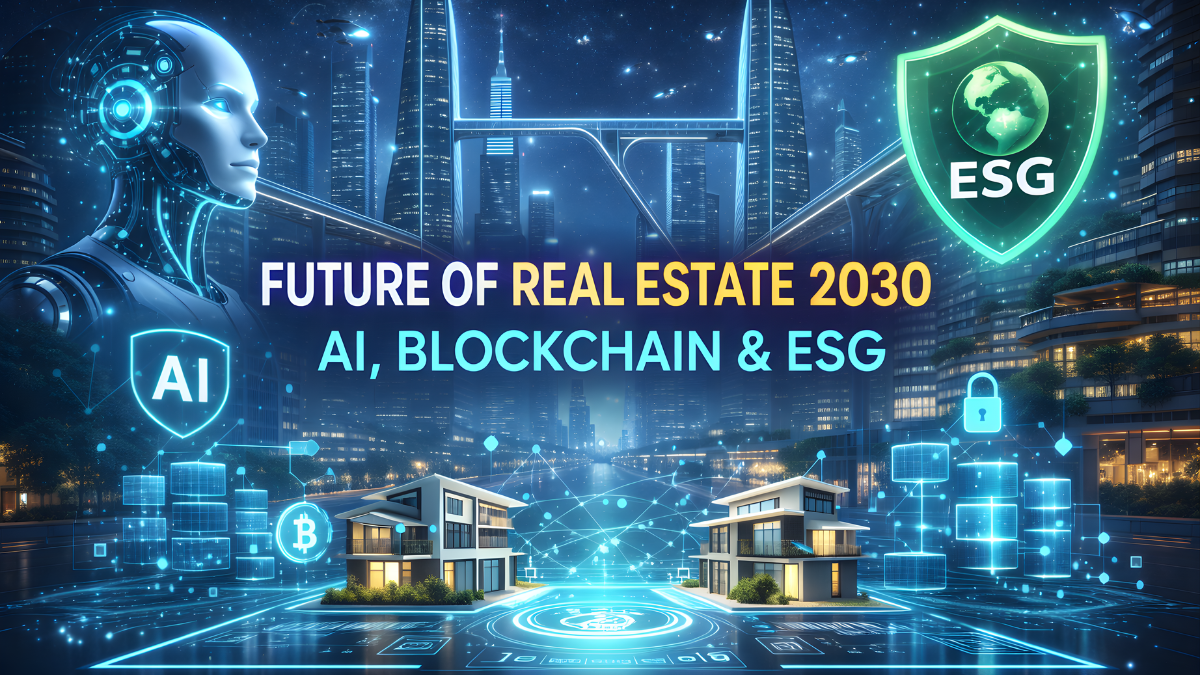
The future of real estate 2030 will look radically different from today. Technology, sustainability, and data-driven intelligence are reshaping how properties are developed, bought, sold, and managed worldwide.
Three pillars are defining this transformation:
Artificial Intelligence (AI)
Blockchain technology
ESG (Environmental, Social & Governance) investing
Together, these forces are building a smarter, greener, and more transparent real estate ecosystem.
 AI in the Future of Real Estate 2030
Artificial Intelligence is becoming the backbone of modern real estate decision-making.
Predictive property price analytics
AI-powered valuation models
Smart tenant screening and fraud detection
Automated property management
Personalized property recommendations
By 2030, AI will reduce investment risks while increasing profitability and operational efficiency.
 Internal Link Suggestion:
 How AI Is Transforming Property Valuation in Dubai
Blockchain in Real Estate 2030: Transparency & TrustBlockchain is redefining ownership and transactions in the real estate sector.
Smart contracts explained automate agreements
Tokenized real estate allows fractional ownership
Immutable land records prevent title fraud
Faster cross-border property investments
Reduced transaction costs
Blockchain will make global property markets more accessible, secure, and liquid.
External Resource:
World Economic Forum on blockchain adoption https://www.weforum.org
 ESG Investing: The Core of Real Estate’s Future
ESG is no longer optional—it is central to the future of real estate 2030.
Lower carbon footprint
Energy-efficient buildings
Higher tenant demand
Government incentives and compliance
Long-term asset value protection
Investors increasingly favor ESG-compliant properties due to stable returns and regulatory alignment.
External Resource:
UN Environment Programme – Sustainable Buildings https://www.unep.org
 Traditional vs Future of Real Estate 2030
| Aspect | Traditional Real Estate | Future of Real Estate 2030 |
|---|---|---|
| Decision Making | Manual analysis | AI-driven analytics |
| Ownership | Full ownership | Tokenized & fractional |
| Transactions | Paper-based | Blockchain smart contracts |
| Sustainability | Optional | ESG-driven |
| Transparency | Limited | Fully transparent |
| Global Access | Restricted | Borderless |
 Smart Cities & Global Property Markets
Cities like Dubai, Singapore, London, and New York are leading the transformation toward smart real estate ecosystems.
Key features include:
AI-powered urban planning
Smart energy management
Blockchain-based property registries
Net-zero construction standards
Internal Link Suggestion: Dubai Real Estate Trends 2026–2030: Smart Growth & Investment Opportunities
 Investment Strategy for the Future of Real Estate 2030
To stay competitive, investors should:
Focus on AI-enabled developments
Choose ESG-compliant projects
Explore blockchain investment platforms
Use data analytics for smarter decisions
Early adopters of these technologies will dominate future real estate markets.
The future of real estate 2030 will be defined by intelligence, transparency, and sustainability. AI improves decision-making, blockchain ensures trust, and ESG secures long-term value.
Investors, developers, and professionals who adapt today will shape tomorrow’s global property landscape.